

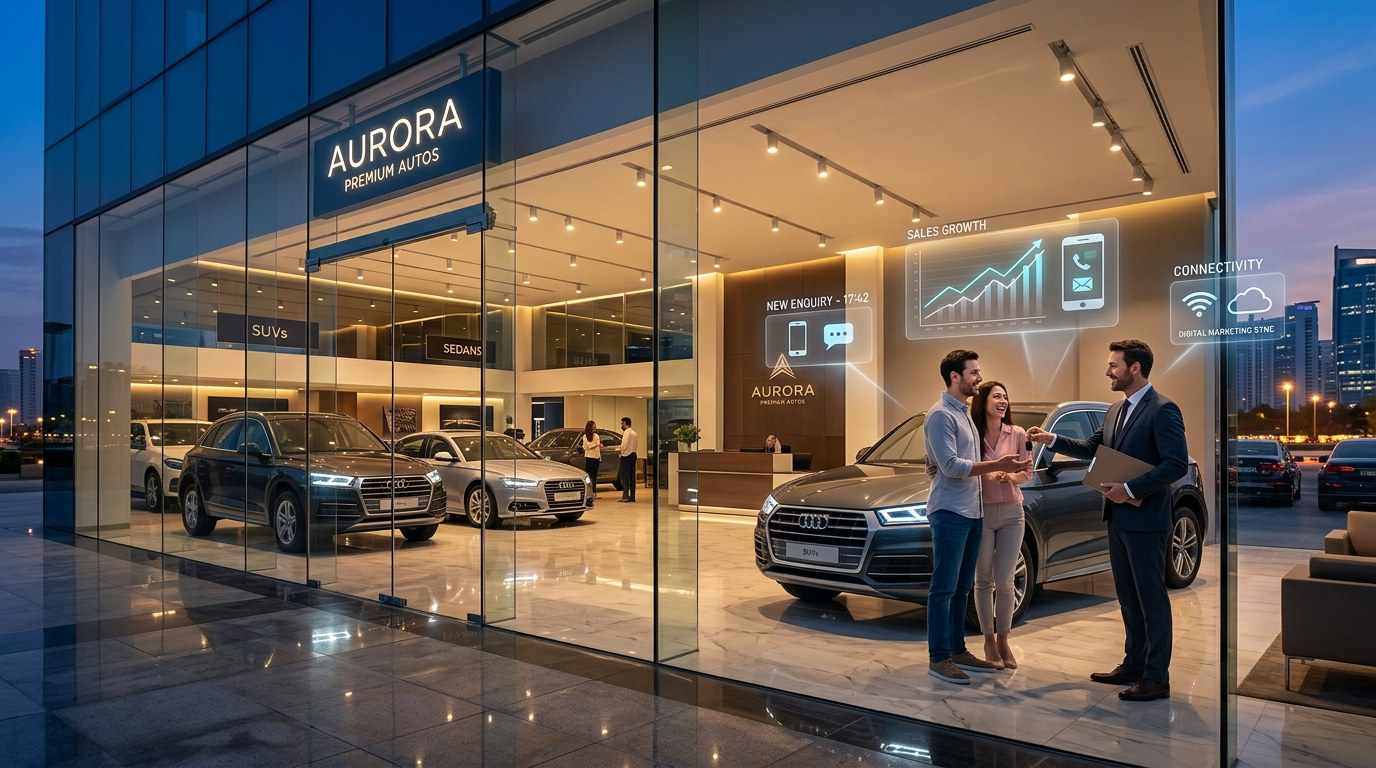
For a Vehicle Showroom, Getting Customers Through the Door Has Always Been the Biggest Challenge
Earlier, dealerships depended heavily on roadside visibility, newspaper advertisements, banners, referrals, local events and walk-in customers.
Those methods can still have value. But today's vehicle buyer usually does something completely different before ever setting foot in a showroom:
They Search
Google variants & pricing
They Compare
Specs, mileage & rivals
They Watch Videos
Walkarounds & test drives
They Check Reviews
Customer experiences
They Look at Prices
On-road calculations
They Explore Models
Features & fuel types
They Search Dealers
Nearby showroom pins
They Ask AI Platforms
AI buyer recommendations
They send WhatsApp messages. They ask questions. And sometimes, they ask AI platforms for recommendations.
By the time a customer walks into your showroom, a large part of their buying journey may already have happened online. This is why digital marketing has become an indispensable driver of dealership growth.
In this guide, we will look at exactly how digital marketing can help a vehicle showroom generate more enquiries, showroom visits, test drives and sales opportunities.
Table of Contents (34 Chapters)
Click any topic below to navigate directly to that chapter.
What Does Digital Marketing Mean for a Vehicle Showroom?
Digital marketing for a vehicle showroom means using online channels to reach potential customers and support them throughout their vehicle-buying journey.
Core Digital Platforms for Vehicle Showrooms:
But simply using these platforms does not automatically increase sales. The real objective is to connect them with the showroom's sales process.
The Dealership Digital-to-Sale Journey:
Digital marketing can influence several stages of this journey.
Why Vehicle Buyers Are Starting Their Journey Online
Think about how you would buy a vehicle today. You may hear about a new model from a friend. Then you search for it on Google. You look at photos. You watch a review. You compare it with another vehicle. You check the price. You search for a showroom near you. You look at Google reviews. You may check Instagram. Then you contact the dealership.
Only after all this might you visit the showroom. Your customers are doing the exact same thing.
This means the showroom that is visible and helpful during this research process has an opportunity to become part of the customer's consideration set.
Digital Marketing Helps Your Showroom Get Found
The first problem digital marketing can solve is simple:
Imagine someone searches:
If your showroom has a strong online presence, there are several places where the customer may discover you:
- Google Search organic results
- Google Maps & Local Pack
- Your official showroom website
- Social media (Instagram & Facebook)
- Paid targeted advertisements
- Authentic online customer reviews
- Automotive directories & portals
- AI search platforms (Perplexity, Gemini, ChatGPT)
If your showroom is difficult to find online, you may lose customers before they ever contact your sales team.
1. Google Ads Can Capture Buyers Who Are Already Searching
One of the biggest advantages of Google Ads is that customers can see your dealership when they are actively searching for something.
They are not simply browsing random content. They are specifically looking for information related to the vehicle and dealership. A Google Search campaign can help your showroom appear for relevant searches.
The customer can then immediately:
- Visit your dedicated vehicle page
- Call your showroom with one tap
- Request specific variant information
- Ask for an immediate test drive
- Contact your sales team on WhatsApp
This can create a direct path from search to enquiry.
But there is an important point:
Running Google Ads does not automatically mean getting good sales. Your keywords, advertisements, landing pages, offers, lead forms, tracking, and sales follow-up all matter. The campaign should be designed around the actual customer journey.
2. Meta Ads Can Create Demand and Generate Enquiries
Facebook and Instagram work differently from Google Search. A person scrolling Instagram may not have searched for a vehicle at that exact moment. But they may still be interested in buying one.
That advertisement can create interest and encourage the customer to enquire. Meta Ads can be particularly useful for:
The important part is targeting the right audience and giving them a clear reason to take action.
3. SEO Helps Your Showroom Get Organic Visibility
Advertising can help you appear when you pay for traffic. SEO works differently. Search Engine Optimization helps your website become more visible in organic search results.
Common Search Examples:
A well-structured dealership website can potentially appear for relevant searches. SEO can help a showroom build visibility around:
SEO is generally a long-term activity rather than a quick replacement for paid advertising.
4. Google Maps Can Bring Local Customers
For most vehicle showrooms, location matters. A customer usually doesn't want to travel hundreds of kilometres just to look at a regular vehicle. They often search for dealerships near their location:
Google Maps can therefore become an important discovery channel. Your Google Business Profile should provide accurate and useful information such as:
A strong local presence makes it easier for potential customers to discover and contact your showroom.
5. A Professional Website Builds Trust
Imagine a customer sees your advertisement. They become interested. What do they do next? Many customers will search for your dealership. They may visit your website.
Now imagine two situations:
The Website Is:
- ✕ Slow to load on mobile
- ✕ Outdated graphics & broken layout
- ✕ Difficult to navigate
- ✕ Missing vehicle information & specs
- ✕ Missing direct contact options
- ✕ Difficult to find showroom location
- ✕ Not mobile-friendly
The Website Clearly Shows:
- High-res vehicle photos & variants
- Key features, specs & comparisons
- Current dealership discounts & offers
- One-click test-drive booking options
- Clear phone & email contact information
- Instant WhatsApp chat integration
- Interactive showroom Google Maps pin
The second experience makes it easier for the customer to continue the buying journey. Your website does not need to be complicated. It needs to answer the customer's important questions and make the next step easy.
7. Video Helps Customers Understand Vehicles Before Visiting
Vehicles are highly visual products. Customers want to see:
A short video can sometimes explain these things better than a long paragraph. A dealership can use Instagram Reels, YouTube videos, Facebook videos, website videos, and vehicle walkarounds.
For example: “5 Features You Should Know Before Buying This SUV” can be far more useful to a potential customer than simply posting: “Visit our showroom today.”
Useful content helps customers during the research stage.
8. Digital Marketing Can Generate More Test Drives
A test drive is an important step in many vehicle purchases. A customer can see hundreds of vehicle photos online. But sitting inside the vehicle and driving it is a completely different experience.
Digital marketing can promote test-drive campaigns. For example:
The customer can click and submit their information. The sales team can then contact them and schedule the appointment. This creates a clear journey:
9. WhatsApp Can Make Customer Communication Easier
Many customers prefer WhatsApp because they can ask questions without making a phone call. A customer may ask:
A showroom can use WhatsApp to continue the conversation. Depending on the setup, WhatsApp can also be used for:
The objective should not be to send unnecessary promotional messages. The objective should be to make communication easier for the customer.
10. Digital Marketing Helps You Reach Customers Outside Your Immediate Area
A showroom's physical location is fixed. Its digital reach is not.
Suppose your dealership is located in Ahmedabad. A customer from another part of the city may discover you through Google or Meta. Similarly, a commercial vehicle dealer may receive enquiries from surrounding towns. Digital marketing allows a showroom to define the geographical area it wants to target.
This is particularly valuable for:
The exact geographic strategy should depend on the showroom's customers and business model.
11. Digital Marketing Helps Promote New Vehicle Launches
New launches create a natural opportunity for digital marketing. Before a new vehicle arrives, customers may already be searching for information: price, features, variants, launch date, availability, specifications, and test-drive availability.
A showroom can prepare its digital presence before and during the launch. A launch campaign might include:
This allows the showroom to communicate across several customer touchpoints.
12. Digital Marketing Can Support Offer and Festival Campaigns
Vehicle dealerships regularly run promotional campaigns: festival offers, exchange offers, finance schemes, corporate discounts, limited-period promotions, model-specific campaigns, and weekend test-drive events.
Digital advertising can help these campaigns reach a local audience. But the advertisement must be crystal clear. Customers should quickly understand:
A clear message usually makes the customer journey easier.
13. Remarketing Helps You Stay Connected With Interested Customers
Not everyone buys after the first interaction. A customer might:
That doesn't necessarily mean they are not interested. They may still be researching. Remarketing can help businesses reconnect with eligible audiences who have previously interacted with their digital properties, subject to platform rules, consent and audience eligibility.
14. Digital Marketing Helps You Educate Buyers
Today's customers have many questions before purchasing:
A dealership can answer these questions through useful content: blog articles, videos, FAQs, social media posts, guides, and comparison content. When a showroom consistently provides useful information, it can become more than a place where customers simply ask for a price. It can become a trusted source of guidance throughout the buying process.
15. AI Search Is Creating Another Discovery Channel
Search behaviour is changing. Customers are increasingly asking AI systems questions rather than typing only traditional keyword searches:
This creates a new area of visibility for businesses. A showroom's website and online presence should make important information easy for search systems to understand: clear business details, accurate location data, structured schema data, strong internal links, and relevant local content.
16. CRM Helps Turn Enquiries Into Sales Opportunities
This is where marketing and sales need to work together. Imagine your campaigns generate 200 enquiries. Where are those enquiries stored? A spreadsheet? Different salespeople's personal phones? WhatsApp chats? Paper registers?
If there is no proper system, some opportunities can easily be missed. A dealership CRM can help organize information such as:
This makes it easier for the sales team to understand what needs attention every single morning.
17. Follow-Up Is Where Many Leads Are Lost
Getting the lead is only the beginning. Suppose a customer enquires about a vehicle. The salesperson calls once. The customer says: “I am still comparing.” The salesperson stops calling. Two weeks later, the customer purchases the vehicle from another showroom.
The marketing campaign may have done its job. The problem happened later. This is why dealerships need a proper follow-up process:
Not every customer needs the same number or type of follow-ups. The important thing is that interested customers should not simply disappear from the system.
18. Digital Marketing Gives You Better Visibility Into What Is Working
Traditional advertising can sometimes make it difficult to understand exactly what happened after someone saw an advertisement. Digital marketing can provide more measurable information:
This allows the dealership to ask better questions. Instead of asking: “How many leads did we get?” you can ask: “How many meaningful enquiries did we generate?” and: “How many of those enquiries became showroom visits?” and eventually: “How many became vehicle sales?”
The Difference Between Leads and Sales
This deserves special attention. Suppose:
The lead numbers tell only part of the story. The actual customer journey tells a completely different story. That is why dealerships should avoid judging every campaign only by the raw count of leads generated.
What Does a Good Automotive Digital Marketing Strategy Look Like?
A good strategy connects different parts of the customer journey across seven defined stages:
Stage 1 — Awareness
Instagram, Facebook, YouTube, Google, SEOThe customer discovers the vehicle or showroom.
Stage 2 — Research
Showroom Website, Vehicle Pages, Walkaround Videos, Blogs, FAQs, ReviewsThe customer starts comparing vehicles, variants, and prices.
Stage 3 — Consideration
Google Search Ads, Remarketing, WhatsApp, Test-Drive Campaigns, Limited-Time OffersThe customer starts considering a specific vehicle model.
Stage 4 — Enquiry
Phone Call, Website Enquiry Form, WhatsApp, Meta Lead Form, Test-Drive BookingThe customer contacts the dealership directly.
Stage 5 — Sales Follow-Up
Immediate Phone Call (< 15 mins), WhatsApp Digital Brochure, Callback SchedulingThe sales team contacts the customer, understands requirements, and schedules an appointment.
Stage 6 — Showroom Visit
Offline sales process, test-drive experience, vehicle walkaround, hospitalityThe customer comes to the dealership for an in-person test drive and inspection.
Stage 7 — Purchase
Finance & insurance finalization, delivery bay handover, CRM loyalty nurtureThe customer completes the buying process and takes vehicle delivery.
Digital Marketing Cannot Fix Every Sales Problem
This is something every showroom owner should understand:
- If the vehicle is unavailable, marketing cannot create inventory.
- If the price is not competitive, advertising cannot guarantee a sale.
- If the sales team does not follow up, more leads may not solve the problem.
- If the customer experience is poor, digital marketing cannot completely compensate for it.
Digital marketing is one part of the dealership's overall sales system. The strongest results usually come when:
7 Common Digital Marketing Mistakes Made by Vehicle Showrooms
Focusing Only on Followers
A showroom may have thousands of followers but receive very few meaningful enquiries. Followers can be useful, but they are not the same as sales opportunities.
Measuring Only Lead Quantity
More leads do not automatically mean more sales. Lead quality and what happens after the lead matters far more.
Running the Same Advertisement for Months
Customers become less responsive to repetitive advertising. Campaigns should be reviewed and refreshed every 2-3 weeks.
Sending Every Lead to the Same Generic Page
Someone interested in a luxury SUV should not receive the same experience as someone looking for a commercial vehicle. The message should match the customer's exact interest.
Ignoring Google Maps
For a local showroom, Google Maps is an essential discovery channel. It should never be treated as an afterthought.
Slow Lead Follow-Up
A customer who is actively considering several dealerships will not wait indefinitely. A dealership must have a clear process for handling new enquiries within 15 minutes.
Not Tracking the Lead Source
If you don't know whether a sale originated from Google, Meta, Organic Search, WhatsApp, or Walk-in, it becomes impossible to know where marketing investment is truly contributing.
How Much Does Digital Marketing Contribute to Vehicle Sales?
There is no single percentage that applies to every dealership. The contribution depends on:
A luxury vehicle dealership and a two-wheeler showroom should not use the same digital strategy. Likewise, a commercial vehicle dealer may have a completely different customer journey from a passenger-car dealership. The strategy needs to be built around the actual business.
How Should a Showroom Measure Digital Marketing?
A useful measurement system should go beyond impressions and clicks. Consider tracking the journey across five key stages:
Marketing Metrics
- Reach & Visibility
- Ad Impressions
- Clicks & CTR
- Website Visitors
Enquiry Metrics
- Direct Phone Calls
- WhatsApp Chats
- Lead Form Fills
- Brochure Downloads
Qualification Metrics
- Relevant Enquiries
- Customer Requirements
- Purchase Timelines
- Budget & Exchange
Sales Activity
- Sales Follow-Ups
- Test Drives Booked
- Home Visits
- Showroom Walk-Ins
Business Results
- Vehicles Sold
- Revenue Generated
- Cost Per Sale
- Lead-to-Delivery %
A Simple Example of Digital Marketing for a Car Showroom
Let's look at a practical example: Suppose a showroom wants to promote a new SUV.
Step 1 — Meta Ads
The dealership runs Instagram and Facebook campaigns introducing the new SUV features and test drive availability.
Step 2 — Website
Interested customers visit a dedicated vehicle page highlighting features, high-res photos, variants, pricing, and test-drive forms.
Step 3 — Google Search
Customers actively searching for the SUV find the showroom through targeted Google Ads and organic SEO visibility.
Step 4 — WhatsApp
Customers ask quick questions about on-road pricing and variant availability directly via WhatsApp.
Step 5 — CRM
Enquiries are automatically captured, tagged with the vehicle model, and assigned to sales consultants.
Step 6 — Follow-Up
The salesperson contacts the customer promptly, understands their timeline, and answers financing questions.
Step 7 — Test Drive
The customer books an appointment for a showroom or home test drive.
Step 8 — Showroom Visit
The customer visits the dealership, inspects the vehicle in person, and negotiates terms.
Step 9 — Sale
The salesperson finalizes financing and documentation, completing the vehicle delivery.
Now digital marketing is not operating separately from sales. It is connected directly to the dealership's customer journey.
What Should a Vehicle Showroom Do First?
If your showroom is starting digital marketing, don't try to do everything at once. Start with the basics:
Step 1 — Understand Your Customers
Know who buys your vehicles, where they live, what models they are interested in, what questions they ask, and who your competitors are.
Step 2 — Build a Strong Online Presence
Make sure your website, Google Business Profile, social profiles, and phone contact details are 100% accurate and professional.
Step 3 — Build a Lead Generation System
Use appropriate channels such as Google Ads, Meta Ads, SEO, and WhatsApp depending on your dealership's sales targets.
Step 4 — Create a Follow-Up Process
Every single enquiry should have an assigned owner and a clear, immediate next step.
Step 5 — Track Results
Don't stop at lead counts. Track what happens after the lead: test drives, showroom visits, and delivered sales.
90-Day Digital Marketing Approach for a Vehicle Showroom
A practical starting framework could look like this:
Build the Foundation
Focus on:
- • Mobile showroom website
- • Google Business Profile
- • Conversion tracking setup
- • Social media branding
- • Basic local SEO
- • WhatsApp Business API
- • CRM & sales workflow setup
Generate and Learn
Run targeted campaigns & test:
- • Different local buyer audiences
- • High-performing creatives & copy
- • Model-specific landing pages
- • Test drive & exchange offers
- • Review customer response rates
Improve the System
Look beyond lead numbers:
- • Which campaigns drove walk-ins?
- • Which models attracted serious buyers?
- • Where were leads dropping off?
- • Which sources closed vehicle sales?
- • Reallocate budget to winners
This is far more effective than simply increasing advertising spend every month without analyzing conversion bottlenecks.
The Future of Automotive Digital Marketing
The automotive buying journey will continue to evolve. Customers will continue to use search engines, social media, video, maps, messaging platforms, websites, and AI search.
But the fundamental requirement will remain the same. Customers want answers:
The dealerships that make these answers easy to find will consistently create a superior digital buying experience.
Final Thoughts: Does Digital Marketing Really Help Vehicle Showrooms Sell More Vehicles?
Yes, digital marketing can play an important role in helping vehicle showrooms generate more business opportunities. But it should not be viewed as a magic button that produces sales automatically.
The real value comes from building a complete system:
That is how digital marketing becomes connected to dealership sales. The goal should not simply be: “We need more leads.”
That is the real role of automotive digital marketing. And for a vehicle showroom, digital marketing works best when marketing and sales stop working as two separate departments and start working as one customer journey.
Frequently Asked Questions
Ready to Turn Digital Interest Into Real Showroom Walk-Ins?
DriveUp Digital builds specialized digital marketing systems strictly for vehicle showrooms. Get a free, comprehensive digital audit of your dealership's Google presence, Meta ads, and local competitor ranking.
6. Social Media Keeps Your Showroom in Front of Potential Buyers
Not every customer will buy a vehicle after seeing one advertisement. Vehicle purchases often take time. A customer might see your showroom today and purchase after two weeks. During that time, they may continue seeing content from your dealership.
This is where social media can help. Your showroom can regularly publish: