

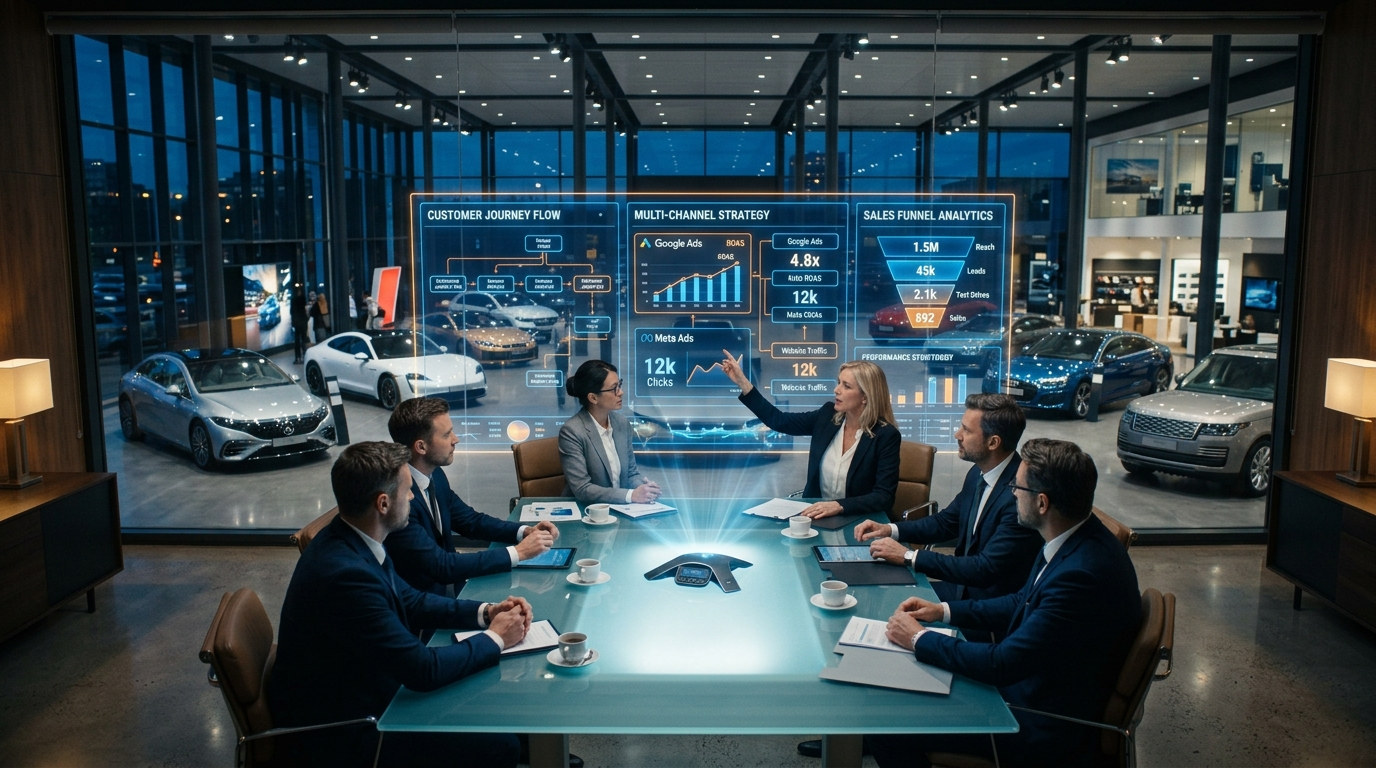
Running Digital Marketing for a Showroom Is Not Simply About Posting on Instagram or Running Ads
A dealership can spend a large amount on advertising and still struggle to generate enough showroom visits or vehicle sales.
Why?
Because digital marketing works best when it is treated as a complete strategy rather than a collection of separate activities. A good strategy connects everything:
The Integrated Dealership Sales Ecosystem:
For a vehicle showroom, every single part of this journey matters. In this guide, we will explain how to build a practical digital marketing strategy for a vehicle showroom — from understanding your market and choosing the right channels to generating enquiries, managing leads and measuring actual business results.
Table of Contents (38 Chapters)
Click any chapter to jump directly to that section.
What Is a Digital Marketing Strategy for a Vehicle Showroom?
A digital marketing strategy is a planned approach for using online channels to help a vehicle showroom achieve its business goals. These goals may include:
The strategy should answer five basic questions:
Without clear answers to these questions, marketing can quickly become a collection of disconnected campaigns.
Why Vehicle Showrooms Need a Different Digital Marketing Strategy
A vehicle showroom is different from many other businesses. A customer usually doesn't see an advertisement and immediately purchase a vehicle. The buying process can involve:
Customers may also compare several dealerships before deciding where to buy. They regularly check:
This means your digital marketing needs to support the customer at different stages of the buying journey.
Step 1: Start With Your Showroom, Not With the Marketing Platform
One of the most common mistakes is starting with: “Should we run Meta Ads or Google Ads?”
Look closely at:
For example, the marketing strategy for a commercial vehicle dealership may be very different from the strategy for a luxury car showroom. The first step is understanding the business.
Step 2: Define Your Target Customers
You cannot build a good marketing strategy if you don't know who you are trying to reach. Different vehicles attract completely different customers:
Potential customers include:
- • College students
- • Working professionals
- • Daily office commuters
- • First-time two-wheeler buyers
- • Value-conscious families
Potential customers include:
- • Growing families
- • Corporate professionals
- • First-time car buyers
- • Existing vehicle owners
- • Customers upgrading segments
Potential customers include:
- • Transport operators
- • Business & factory owners
- • Fleet logistics managers
- • Construction contractors
- • Self-employed drivers
The more clearly you understand your customers, the easier it becomes to create relevant campaigns.
Step 3: Understand Your Local Market
Vehicle dealerships are strongly connected to geography. A showroom in Ahmedabad may target a different market from a showroom in Surat, Rajkot or Delhi. Start by identifying:
Also understand how far customers are realistically willing to travel for your particular vehicle category. For some dealerships, the market may be concentrated around a few kilometres. For others, especially specialized or commercial vehicle businesses, customers may come from a much larger area.
Step 4: Study Your Competitors
Competitor research is not about copying another showroom. It is about understanding the market. Search for your competitors on Google, Google Maps, Instagram, Facebook, and YouTube. Look at:
This question is often far more useful than simply asking what competitors are doing.
Step 5: Set Clear Marketing Goals
Do not start with a vague goal like: “We want more digital marketing.” Set specific business objectives:
Increase enquiries for a particular high-margin vehicle model.
Generate more test-drive bookings for upcoming weekends.
Increase footfall and physical showroom walk-ins.
Improve local Google search visibility and map pack rank.
Increase enquiries from a specific developing catchment area.
Improve sales follow-up speed and lead-to-sale tracking.
Your goals will determine which channels and campaigns you need.
Step 6: Build Your Digital Foundation
Before spending heavily on advertising, make sure the basic digital presence is ready. Your foundation should include:
1. Showroom Website
Your website should clearly communicate what vehicles you sell, where your showroom is located, how customers can contact you, how they can request information, and how they can book a test drive. It must work flawlessly on mobile devices.
2. Google Business Profile
Make sure your dealership information is accurate: showroom name, address, phone number, opening hours, website link, high-res photos, reviews, and primary business category. This is especially vital for local searches.
3. Social Media Profiles
Your Facebook and Instagram profiles should look active and professional. Customers regularly check social media for real delivery celebrations and showroom trust before contacting a dealership.
4. Conversion Tracking
Make sure every important customer action can be measured: form submissions, phone calls, WhatsApp clicks, test-drive requests, and brochure downloads. Without tracking, it becomes difficult to understand what your marketing is producing.
Step 7: Choose the Right Digital Marketing Channels
You do not need to use every platform simply because it exists. Choose channels according to your customers and objectives. The main channels for a vehicle showroom can include:
Google Ads
Useful for capturing buyers actively searching for vehicles, dealerships and pricing.
Meta Ads
Reaching relevant local audiences on Facebook and Instagram for test drives, offers and launches.
Dealership SEO
Building long-term organic visibility in search engine results for model and showroom keywords.
Google Maps / Local SEO
Critical for nearby discovery, directions requests, and 'dealers near me' searches.
Social Media
Building brand awareness, showcasing vehicle walkarounds, and staying top-of-mind.
YouTube
Vehicle walkarounds, feature breakdowns, variant comparisons, and buyer guides.
WhatsApp Business
Instant buyer communication, brochure delivery, appointment confirmation, and follow-up.
AI Search Optimization
Ensuring your business and models are discoverable across emerging AI search systems.
Dealership CRM
Organizing buyer enquiries, assigning sales executives, and tracking lead status to delivery.
Step 8: Build Your Strategy Around the Customer Journey
This is one of the most important parts of the strategy. Instead of thinking: “We need Facebook Ads,” think: “Where is the customer in the buying journey, and what should we show them next?”
1. Awareness
The customer discovers a vehicle or showroom.
2. Research
The customer wants more detailed information.
3. Consideration
The customer is seriously comparing shortlist options.
4. Enquiry
The customer contacts the showroom directly.
5. Visit
The customer comes to the showroom for a test drive.
6. Purchase
The sales team completes the offline buying process.
The marketing strategy should support this entire journey.
Step 9: Create Vehicle-Specific Campaigns
Avoid promoting everything in one generic campaign. Suppose your showroom sells five different vehicle models. Each model may have a different customer, price range, USP, buying reason, competition, and demand level.
Create campaigns around specific business objectives:
This gives your marketing a much clearer purpose.
Step 10: Create Different Messages for Different Customers
A common dealership advertisement says: “Visit Our Showroom Today.” There is nothing wrong with this, but it may not give the customer enough reason to act.
Instead, think about the customer's actual requirement:
“Looking for your first car? Explore the latest models, calculate easy EMIs, and book a friendly test drive.”
“Looking for a safe, comfortable 7-seater SUV? Experience spacious seating and premium safety with a weekend test drive.”
“Looking for a reliable vehicle for your transport business? Enquire about payload, low maintenance, and custom fleet financing.”
The message should connect directly with the customer's reason for buying.
Step 11: Build Strong Landing Pages
If you are spending money to bring customers to a website, don't send everyone to a generic homepage. A customer clicking an advertisement for a specific vehicle should ideally reach a dedicated page related to that vehicle or campaign.
A High-Converting Dealership Landing Page Includes:
The customer's next step should be completely obvious.
Step 12: Make It Easy to Enquire
Every extra step creates friction. If a customer wants information, make it easy to:
Don't make the customer search through menus to find your phone number. Your important contact options should be easy to find, especially on mobile.
Step 13: Create a Proper Lead Management System
This is where marketing connects with the sales team. Every enquiry should ideally be captured, tagged, and organized:
| Lead | Vehicle Model | Source Channel | Current Status |
|---|---|---|---|
| Customer A | SUV Top Variant | Meta Ads | Follow-Up |
| Customer B | Executive Sedan | Google Search | Test Drive |
| Customer C | Commuter Bike | Website Form | New |
| Customer D | Commercial Truck | Negotiation |
A CRM can make this process much easier. The exact system will depend on the dealership's size and sales structure.
Step 14: Create a Lead Follow-Up Process
A digital marketing strategy should not end when a lead is generated. Define what happens next:
The exact process should be customized to the dealership. The important thing is that everyone knows what happens after a new enquiry arrives.
Step 15: Connect Marketing With Sales Data
This is where many dealerships can dramatically improve their marketing decisions:
300 Raw Leads
100 Raw Leads
Looking only at lead numbers, Meta appears to have generated more. But looking at sales opportunities, Google produced superior business value. This is why marketing decisions should consider the quality and progression of enquiries, not only the number of leads.
Step 16: Track the Right KPIs
Your digital marketing dashboard should monitor four tiers of metrics:
- • Reach & impressions
- • Clicks & CTR
- • Website traffic
- • Cost per click (CPC)
- • Total enquiries
- • Cost per enquiry
- • Phone calls & WhatsApp
- • Form submissions
- • Qualified leads
- • Timely follow-ups
- • Test drives booked
- • Showroom walk-ins
- • Sales opportunities
- • Vehicles sold
- • Lead-to-sale %
- • Revenue generated
Step 17: Don't Ignore Organic Marketing
Paid advertising can generate traffic quickly. But a strong dealership should also build its organic presence: SEO, Google Maps, social media, YouTube, website content, customer reviews, local content, and helpful buyer guides.
For example, a dealership can create content around questions customers commonly ask:
This type of content helps customers during their crucial research stage.
Step 18: Build Local SEO Into the Strategy
A vehicle showroom needs to be visible in its local market. Your SEO strategy should not focus only on broad national vehicle keywords. Consider relevant localized searches:
The exact keywords should be based on actual search behaviour and dealership business relevance.
Step 19: Build Your Google Business Profile Properly
Your Google Business Profile is an indispensable driver of local discovery. Keep it updated with correct business information, current photos, accurate opening hours, vehicle/service categories, authentic customer reviews, prompt review responses, and verified map location.
Step 20: Build Content Around Real Customer Questions
Don't create content simply because a keyword was found in an SEO tool. Start with actual customer questions. Your sales team is a goldmine of content ideas:
- What do customers ask on phone calls every single day?
- Which specific vehicle features confuse buyers the most?
- Which trim variants are difficult to explain?
- What objections do customers have before booking?
- Why do customers delay purchasing or comparing?
- What questions come right before booking a test drive?
These questions can become blogs, videos, FAQs, social posts, and website content — making your dealership more helpful and authentic.
Step 21: Use Reviews as Part of Your Digital Strategy
Before visiting a dealership, customers look at online reviews. Encourage genuine customers to share their delivery experiences. Reviews provide crucial social proof regarding customer service, the buying experience, staff interaction, delivery celebrations, and the overall showroom environment.
Step 22: Use Video as Part of the Strategy
Video is especially useful for vehicle businesses:
Vehicle Walkarounds
Show exterior styling and interior space from multiple angles.
Feature Videos
Explain infotainment, ADAS, and safety features simply.
Comparison Videos
Demonstrate differences between variants or rival models.
Delivery Celebrations
Show authentic key handovers and happy families.
FAQ Videos
Answer the most common buyer questions in 60 seconds.
Test-Drive Content
Show what customers will experience during a showroom drive.
The goal is not to produce cinema-quality videos every time. Useful and authentic content can be more valuable than overly complicated production.
Step 23: Build a Remarketing Strategy
Not everyone who visits your website will contact you. Not everyone who watches your video will book a test drive. Not everyone who submits an enquiry will buy immediately.
Remarketing helps reconnect with eligible audiences who previously interacted with your digital properties: visited a specific vehicle page, engaged with social content, watched a video, or visited a campaign page. The message should match the customer's previous interaction rather than simply repeating the same advertisement.
Step 24: Plan Your Monthly Campaign Calendar
A dealership shouldn't decide what to advertise every morning. Build a structured monthly plan:
Vehicle Awareness & Highlights
Feature & Educational Content
Test-Drive Drive Campaign
Limited-Time Offers & Booking Push
Alongside this, maintain continuous background operations: SEO, social media, Google Business Profile, WhatsApp follow-up, remarketing, and CRM management.
Step 25: Plan Around Important Automotive Events
Your strategy should prepare for dealership milestones: new vehicle launches, festive seasons (Diwali, Navratri, Dhanteras), exchange carnivals, corporate discount drives, model facelift updates, and showroom test-drive events. Prepare all marketing assets beforehand: creatives, videos, landing pages, lead forms, and sales follow-up scripts.
Step 26: Decide Your Budget
There is no universal digital marketing budget for every vehicle showroom. The right budget depends on your vehicle category, inventory, location, competition, and sales targets.
Don't decide your budget only by asking: “What are other dealerships spending?” Start with your business goals and customer acquisition economics.
Step 27: Don't Increase Ad Spend Before Fixing the Process
Suppose your showroom receives 500 enquiries but struggles to follow them up. Increasing the advertising budget simply adds more leads to an already overloaded sales team.
Before increasing spend, audit: lead response speed, salesperson assignment, callback discipline, test-drive scheduling, and CRM tracking. Sometimes the next improvement is not another advertisement; it is improving what happens after the advertisement.
Step 28: Review Your Strategy Every Month
Digital marketing is not a “set it and forget it” activity. Every month, review:
What worked?
Which campaigns generated meaningful showroom walk-ins and test drives?
What didn't work?
Which campaigns produced high spend but weak lead qualification?
Which vehicles generated interest?
Analyze model-level performance and stock movement.
Where are leads getting lost?
Audit the sales handover and callback speed.
Make decisions based on actual showroom data rather than assumptions.
A Practical Digital Marketing Framework for Vehicle Showrooms
You can simplify the entire strategy into six core parts:
1. Attract
Use Google + Meta + SEO + Social Media + YouTube + Local Search to attract potential buyers.
2. Educate
Use Showroom Website + Videos + Blogs + FAQs to help customers compare models.
3. Capture
Use Lead Forms + Website + Phone + WhatsApp + Test-Drive Forms to capture enquiries.
4. Follow Up
Use Sales Team + WhatsApp + CRM + Calls to continue the conversation promptly.
5. Convert
Move interested customers toward Test Drive → Showroom Visit → Purchase.
6. Measure
Track Enquiry → Qualified Lead → Test Drive → Visit → Final Sale.
What a 90-Day Strategy Can Look Like
If a showroom is starting from scratch, the first three months can be structured around building and improving the system:
Foundation
Focus on:
- • Market & competitor research
- • Website audit & optimization
- • Google Business Profile setup
- • Conversion tracking installation
- • Social media branding
- • Lead forms & WhatsApp API
- • CRM lead handling workflow
Lead Generation
Launch campaigns on:
- • Google Search Ads for in-market intent
- • Meta Ads for models & test drives
- • Local SEO & map visibility
- • Test creative & copy variations
- • Model-specific landing pages
- • Track early conversion rates
Optimization
Analyze & scale:
- • Qualified leads vs raw clicks
- • Weekend test-drive completions
- • Showroom walk-in conversion
- • Sales consultant follow-up speed
- • Model-level ROI and delivery numbers
- • Reallocate budget to winners
9 Common Mistakes When Building a Dealership Strategy
1. Starting With Platforms Instead of Goals
"Let's run Facebook Ads" is not a strategy; it is a channel decision. Start with the business objective.
2. Trying to Promote Every Vehicle Equally
Not every model needs the same marketing investment. Prioritize based on inventory and business margins.
3. Focusing Only on Leads
A lead is not a sale. Track what happens after the enquiry: qualified leads, test drives, and bookings.
4. Ignoring the Sales Team
Marketing and sales must work in complete alignment with shared definitions of lead qualification.
5. Sending Leads Without a Follow-Up System
Generating enquiries without managing them properly wastes valuable dealership opportunities.
6. Ignoring Local Search
A dealership is a local business. Google Maps and local search prominence directly drive walk-ins.
7. Using Generic Content
Customers don't need another generic holiday banner. Provide real vehicle walkarounds and transparent information.
8. Blindly Copying Competitors
Your competitor's campaign may be serving their particular inventory, but not necessarily yours.
9. Measuring Only Clicks and Impressions
Vanity metrics look pretty on charts, but they don't sell vehicles or pay dealership bills.
How Marketing and Sales Should Work Together
The most important shift for a dealership is to stop treating marketing and sales as completely separate activities. Marketing should generate opportunities; sales should work those opportunities; CRM should connect the two:
That final step is vital: when marketing learns which enquiries actually become meaningful sales opportunities, future campaigns can be planned more intelligently.
The Real Goal of a Dealership Digital Marketing Strategy
The goal is not more followers. It is not more website traffic. It is not even simply more leads.
The bigger objective is to build a predictable digital system that helps your showroom connect with potential buyers:
Reach the right people → Create interest → Generate enquiries → Follow up → Bring customers to the showroom → Support the sales process → Measure the result
Every showroom will have different numbers and different challenges. But the framework remains universally useful.
Final Thoughts
Building a digital marketing strategy for a vehicle showroom does not start with choosing between Google Ads and Meta Ads. It starts with understanding the business, the customer, and the sales process.
Once you understand those three things, the rest becomes much clearer: where your customers are searching, what content they need, which advertising channels make sense, what pages they should visit, how they should enquire, how the sales team should follow up, and what should be measured.
And when all of these parts work together, digital marketing becomes much more than an online promotion channel. It becomes an integral part of the showroom's overall vehicle sales process.
Frequently Asked Questions
Ready to Build a Winning Digital Strategy for Your Vehicle Showroom?
DriveUp Digital builds bespoke, revenue-driven automotive digital marketing strategies for dealerships across India. Get a free audit and customized strategy roadmap for your showroom.