

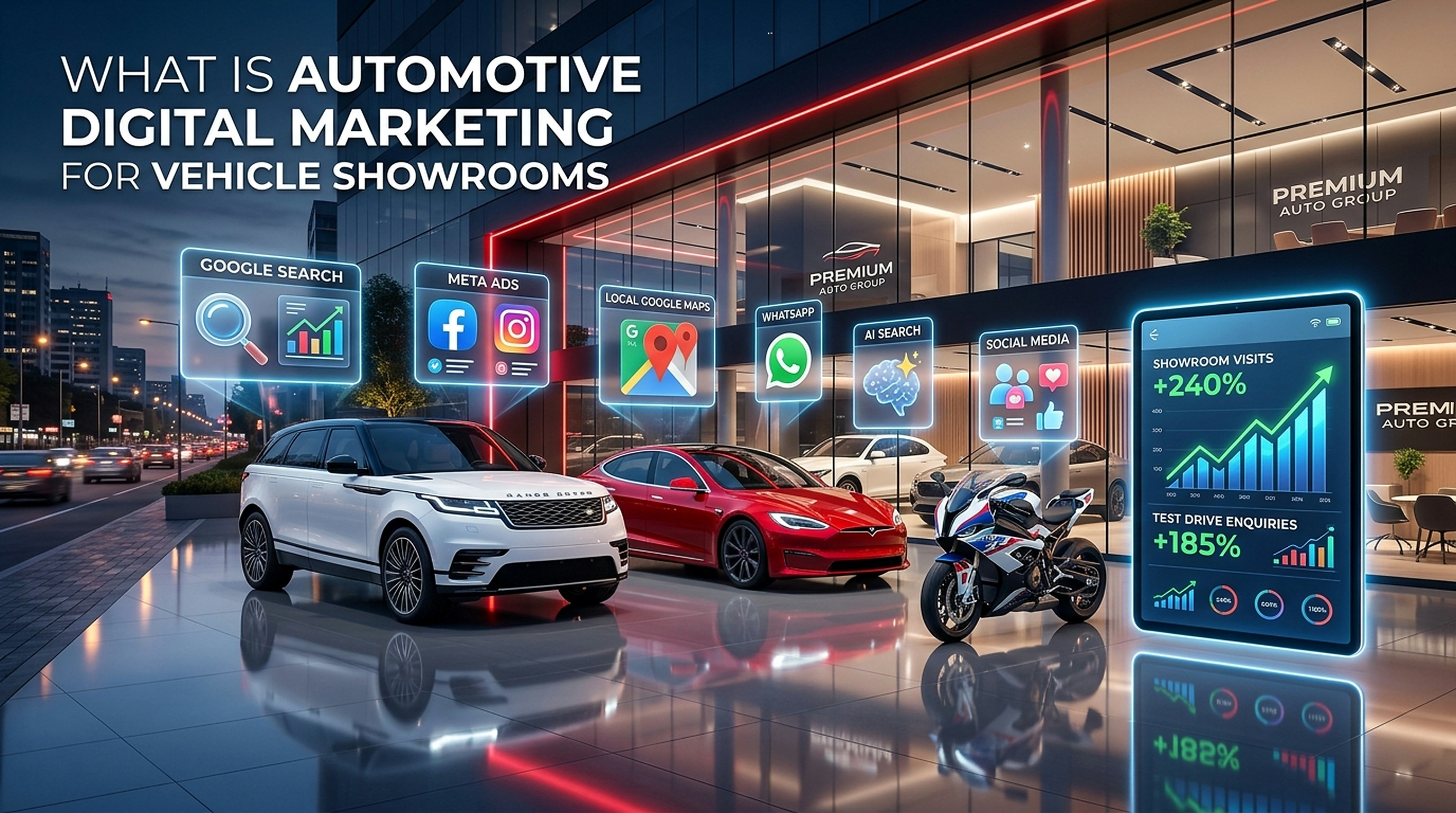
Buying a Vehicle Has Changed
A few years ago, a customer might see a vehicle on the road, visit the nearest showroom, speak with a salesperson, compare a few models, and then make a decision.
Today, the process starts much earlier — on the internet.
Traditional Showroom Walk-in
- •Saw a car or bike on the road or in print
- •Walked into the showroom without prior research
- •Salesperson explained all features and specs from scratch
- •Showroom had full control over the information flow
The Digital-First Buyer
- Searches Google for prices, variants, and mileage
- Watches YouTube comparisons, reviews, and walkarounds
- Inspects dealership Google Maps ratings and customer reviews
- Reaches out via WhatsApp or ad enquiry already knowing their exact model
By the time that customer walks into your showroom, they may already know the model they want, its features, approximate price, and even which specific showroom they want to visit.
Table of Contents (All 15 Chapters)
Click any topic to jump directly to that chapter in this guide.
What Is Automotive Digital Marketing?
Automotive digital marketing is the strategic use of online channels and digital tools to promote vehicles, reach potential buyers, generate qualified enquiries, and help vehicle showrooms increase retail sales.
The Complete Digital Marketing Toolkit for Showrooms:
The important thing is not simply being present on all these platforms.
The Real Question Every Dealer Must Ask:
“Can our digital marketing help a potential buyer move from online interest to a showroom enquiry, physical visit, test drive, and eventually a vehicle purchase?”
That is the vital difference between simply “doing digital marketing” and building a high-performance digital marketing system for a showroom.
Why Is Automotive Digital Marketing Different?
A vehicle is not an everyday purchase. Someone may buy groceries or clothes online within minutes. A vehicle purchase involves extensive family discussions, financial planning, and exhaustive technical research.
What Customers Compare Before Stepping Into a Showroom:
The customer may take days, weeks, or even months before making a final buying decision. That means a showroom's digital marketing must consistently support the customer throughout this entire journey:
The End-to-End Buyer Journey Supported by Digital:
How Do Vehicle Buyers Use Digital Channels?
Imagine someone is planning to buy a new vehicle. Their modern decision-making process typically unfolds across 5 distinct digital stages:
They Start Searching (Information Discovery)
At this stage, they are gathering raw information. They search broad queries on Google and YouTube.
Common Searches & Actions at this Step:
They Start Comparing (Deep Research)
They watch YouTube comparison videos, read expert reviews, and check variant breakdowns to narrow their shortlist.
Common Searches & Actions at this Step:
They Become Interested in a Specific Vehicle (High Intent)
Their searches shift from generic browsing to high-intent transactional queries.
Common Searches & Actions at this Step:
They Look for a Showroom (Local Dealership Discovery)
The buyer checks Google Maps or local search to find where to inspect the vehicle in person.
Common Searches & Actions at this Step:
They Contact the Showroom (The Sales Opportunity)
The final digital step before footfall. The buyer reaches out to schedule their visit.
Common Searches & Actions at this Step:
What Does Automotive Digital Marketing Include?
Automotive digital marketing is not one single service. It is an orchestra of 8 specialized activities working harmoniously to generate predictable dealership growth:
1. Meta Ads (Facebook & Instagram)
Visual campaigns showcasing vehicle launches, seasonal festive offers, finance schemes, and instant test-drive campaigns targeted strictly by locality and buyer demographics.
2. Google Ads (Search & Local)
Captures buyers at the exact moment of intent when they actively search terms like “Car showroom in Ahmedabad” or “Maruti dealer near me.”
3. Search Engine Optimization (SEO)
Positions your showroom website at the top of organic Google rankings for local searches like “Best car showroom in [City]” or “TVS dealer near me.”
4. Google Business Profile & Maps
For local showrooms, Google Maps is the number-one driver of physical footfall. Customers check verified opening hours, 5-star reviews, delivery photos, and driving directions.
5. Social Media Marketing
More than posting generic stock photos. It showcases happy customer delivery keys, walkaround videos, festival celebrations, and vehicle feature demonstrations.
6. High-Converting Dealer Website
Your 24/7 digital showroom. It must be mobile-first, lightning-fast, and display inventory models, specifications, exchange tools, and WhatsApp inquiry buttons.
7. Official WhatsApp Marketing & Automation
Indian vehicle buyers prefer WhatsApp over email. Use WhatsApp Business API for instant enquiry follow-ups, brochure PDFs, test-drive booking reminders, and quotation sharing.
8. AI Search & Answer Engine Optimization
Buyers are asking ChatGPT, Google Gemini, and Perplexity questions like “Which SUV should I consider under ₹20 lakh in Ahmedabad?”
Is Automotive Digital Marketing Just About Getting Leads?
No. This is one of the biggest misunderstandings in dealership marketing.
Getting an enquiry is only the beginning. Consider this common dealership scenario:
What Happens When 100 Enquiries Are Generated:
Result: The campaign generated 100 genuine enquiries, yet the showroom owner says “digital marketing doesn't work” because retail sales did not increase.
That is why automotive digital marketing must be seamlessly connected with the dealership sales process:
The Connected Dealership Sales Pipeline:
What Is the Difference Between General Marketing and Automotive Digital Marketing?
The basic digital advertising tools are the same. The difference is how they are used. A general digital agency works with restaurants, clothing shops, schools, and dentists. A vehicle dealership has a completely different operational reality:
| Marketing Dimension | General Digital Marketing Agency | Specialized Automotive Marketing (DriveUp) |
|---|---|---|
| Target Focus | Generic impressions, clicks, and vanity likes | Real buyers, test drives, and showroom walk-ins |
| Product Knowledge | Treats a ₹15L SUV like a ₹500 t-shirt or burger | Understands variants, engines, fuel types, & on-road prices |
| Inventory Alignment | Promotes unavailable models causing dealer frustration | Targeted campaigns for actual yard stock needing liquidation |
| OEM Guidelines | Violates manufacturer logos, colors, and font rules | 100% compliant with strict OEM brand guidelines |
| Sales Integration | Hands over an Excel sheet at month-end and walks away | Connects directly into CRM, tracking lead-to-visit rates |
What Are the Main Goals of Automotive Digital Marketing?
A vehicle showroom uses digital marketing to achieve 6 clear, measurable business objectives:
Brand Visibility
Make more local car & bike buyers in your territory aware of your showroom.
Vehicle Enquiries
Encourage prospective buyers to ask about on-road pricing, variants, and stock.
Test-Drive Bookings
Generate appointments for showroom and doorstep test drives.
Physical Showroom Visits
Convert online interest into real footfall across your showroom floor.
Continuous Follow-Up
Nurture buyers comparing options who aren't ready to buy today.
Retail Vehicle Sales
Support your sales consultants in hitting monthly and quarterly sales targets.
Why Do Some Showrooms Get Leads but Not Sales?
This is the most common dealership complaint: “We are getting leads from our agency, but our sales are not increasing.”
The 9 Critical Dealership Sales Leak Points:
What Should a Vehicle Showroom Measure?
Stop looking at vanity numbers like ad impressions or video views. Focus on metrics that directly impact your dealership profit and loss:
Upper Funnel (Enquiry Quality)
- • Website enquiry forms & test drive bookings
- • Inbound direct phone calls from Google Maps
- • Verified WhatsApp chats initiated by buyers
- • Cost Per Qualified Enquiry (CPQE)
Lower Funnel (Showroom Conversion)
- • Physical showroom visits from digital leads
- • Completed test drives logged in CRM
- • Lead-to-Visit Rate (Target: 15%–25%)
- • Visit-to-Sale Rate (Target: 20%–35%)
- • Total retail sales and net profit per campaign
Does Every Vehicle Showroom Need Every Digital Marketing Channel?
No. A showroom does not need to spend money everywhere. The ideal channel mix depends heavily on your vehicle category:
Luxury Car Showrooms
Prioritize Google Search Ads (High-intent keywords), exclusive Meta video retargeting, and Google Business Profile reputation management.
Two-Wheeler & EV Dealers
Focus heavily on Instagram Reels (commute savings, features), Google Maps local searches, and fast WhatsApp test-drive booking automations.
Commercial Vehicle Dealerships
Emphasize local B2B Google Search, WhatsApp EMI calculators, fleet finance promotions, and local transport hub targeting.
Multi-Brand Used Car Showrooms
Dynamic inventory ads, fast website inventory filters, Google Maps trust badges, and WhatsApp video walkarounds of certified stock.
What Does a Simple Automotive Digital Marketing System Look Like?
Instead of overcomplicating, high-performing showrooms deploy this simple 5-stage blueprint:
Google Search + Meta Ads + Local SEO + Google Maps + Social Media + AI Search
Get discovered by vehicle buyers actively searching in your city territory.
Fast Website + Direct Call Buttons + Official WhatsApp + Instant Lead Forms
Make it effortless for potential buyers to get in touch within 2 clicks.
Automated CRM Routing + 15-Minute Calling SLA + WhatsApp Brochure Automation
Ensure every enquiry reaches your sales consultants instantly.
Confirmed Showroom Appointments + Doorstep Test Drives + Trade-in Appraisals
Move interested digital leads to the showroom floor and into the driver's seat.
Cost Per Qualified Lead + Showroom Footfall Tracking + Retail Sales Attribution
Double down on marketing channels that generate real vehicle deliveries.
Automotive Digital Marketing Is More Than Advertising
This is perhaps the simplest way to understand the concept:
Advertising brings temporary attention.
A Digital Marketing System builds the complete path from attention to showroom sale.
A showroom may run an ad today. But a customer may discover your showroom through Google Search next month. Another buyer may find you through Google Maps. Someone else may watch an Instagram reel first. Another buyer may ask an AI assistant about dealerships in their city.
All of these touchpoints form the modern vehicle buying journey. That is why automotive digital marketing must be treated as a long-term business asset, not just a monthly advertising expense.
Final Thoughts
Automotive digital marketing simply means using digital channels to help vehicle showrooms get discovered, connect with potential buyers, generate qualified enquiries, and support the entire journey toward showroom visits, test drives, and vehicle sales.
The 3 Rules of Dealership Marketing Success:
- Be visible where vehicle buyers are looking (Google, Meta, Maps, WhatsApp, AI).
- Make it effortless for buyers to contact your dealership with zero friction.
- Build a sales-connected system that turns digital interest into real test drives and delivered vehicles.
Frequently Asked Questions
Ready to Turn Digital Interest Into Real Showroom Walk-Ins?
DriveUp Digital builds specialized digital marketing systems strictly for vehicle showrooms. Get a free, comprehensive digital audit of your dealership's Google presence, Meta ads, and local competitor ranking.